Rising Tides Credit Card Review 2026: Impact Banking & Credit Building
Rising Tides Credit Card Review 2026: Impact Banking & Credit Building
Important Note: What “Rising Tides” Actually Means
Before diving in, one thing needs to be said clearly — “Rising Tides” is not a single, nationally recognized credit card brand. It is a concept and descriptor used across the financial industry to refer to community-focused credit products offered by CDFIs (Community Development Financial Institutions), credit unions, and social-impact fintechs. Several local institutions use variations of this name for their credit-building products.
This review covers the broader category of impact-driven credit cards — what they offer, who they are genuinely best for, and how to find the right one in your area. If you came here looking for a specific product, the best path is to search for CDFI-backed or community credit union cards available in your state.
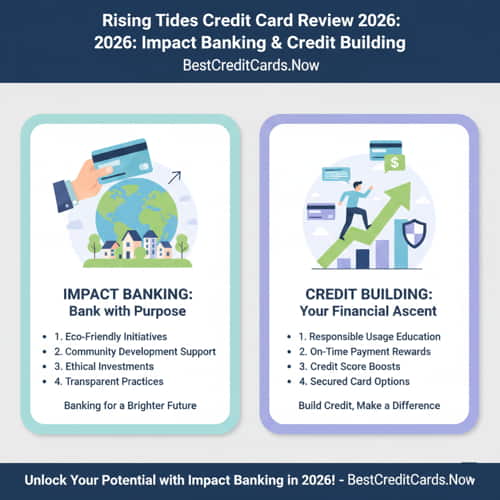
Introduction: A New Kind of Credit Card for 2026
Something is shifting in how Americans think about credit cards. Yes, cash back and travel rewards still dominate the conversation — but a growing segment of consumers, particularly younger ones, are asking a different question: Where does my money actually go?
Impact banking answers that question. Cards built on the “rising tide” model are designed around a simple principle — that lifting individual financial health and supporting the broader community are not competing goals. They can happen together.
In 2026, this model has become more relevant than ever. Credit card interest rates have hovered around an average of 22% all year, and economically speaking, 2025 was a tough year for many Americans. Bankrate Against that backdrop, community-focused cards offering lower rates, alternative approval criteria, and genuine reinvestment into local economies represent a real alternative worth understanding.
1. What Is an Impact-Driven Credit Card?
Impact-driven or “rising tide” style cards typically share several defining characteristics that set them apart from mainstream bank products.
Mission-aligned underwriting: Rather than relying solely on a FICO score, many of these cards use alternative data — rent history, utility payments, bank account management — to assess creditworthiness. This makes them genuinely accessible to people who have been shut out by traditional lenders. The mechanics behind this approach are explained in detail in How to Get a Credit Card with No Credit History in 2026: Your Starter Guide.
Community reinvestment: A portion of interchange fees (what merchants pay every time you swipe) is directed toward low-interest microloans for local small businesses, housing initiatives, or financial literacy programs in underserved communities. Your morning coffee purchase, in a small but real way, funds something beyond a bank’s bottom line.
Transparent fee structures: Most impact cards are built around accessibility — low or no annual fees, capped late fees, and no hidden charges. The contrast with large bank cards can be striking.
Full bureau reporting: Regardless of size, legitimate impact cards report to all three major credit bureaus — Equifax, Experian, and TransUnion — giving cardholders the same credit-building power as any mainstream product.
2. Who These Cards Are Actually Built For
Impact-driven credit cards are best suited for three specific groups of people.
The credit invisible: An estimated 26 million Americans have no credit file at all, and another 19 million have files too thin to generate a score. Traditional banks pass on these applicants entirely. Community-backed cards with alternative underwriting are often the only realistic entry point. Best Credit Cards to Build Credit in 2026 covers both impact cards and secured options across this category.
People rebuilding after financial hardship: A medical crisis, job loss, or divorce can devastate a credit profile. Impact cards designed for rebuilding typically offer lower APRs than mainstream “bad credit” cards, which tend to charge 28–36%. Best Credit Cards for Bad Credit in 2026 compares your options at this stage.
Values-driven consumers: Increasingly, Americans — particularly Gen Z and millennials — want their financial choices to reflect their values. Younger consumers are less likely to stick to one way of paying for purchases Bankrate, and community-focused cards with real social reinvestment models appeal directly to this mindset.
3. The 2026 Economic Case for Impact Banking
The argument for community-focused financial products has only strengthened in the current economic environment.
US tariff escalations throughout 2025–2026 drove consumer prices higher across essentials — groceries, housing, transportation. Household financial stress increased measurably, with credit card delinquency rates rising for the second consecutive year. The Consumer Financial Protection Bureau’s power and staff were cut way back beginning in February 2025, Bankrate reducing federal oversight of predatory lending practices.
In this environment, CDFIs — which are regulated but mission-driven — fill a genuine gap. The CDFI Fund, administered by the US Treasury Department, certifies and partially funds these institutions, giving them a level of institutional legitimacy that informal community lenders lack.
Meanwhile, Capital One officially acquired Discover in May 2025, making it the largest credit card issuer in the US Bankrate — a consolidation that makes community-scale alternatives more meaningful, not less.
4. How to Find a Legitimate Impact Card in Your Area
Because “Rising Tides” is a concept rather than a single brand, the path to finding the right product requires a bit of research. Here’s where to look:
CDFI Locator: The US Treasury’s CDFI Fund locator tool lets you search certified CDFIs by state. Many offer credit cards or secured card products directly.
Local credit unions: Credit unions are member-owned, not-for-profit institutions that regularly outperform large banks on APR, fee structure, and customer service. Use the National Credit Union Administration’s locator to find federally insured credit unions near you.
Mission-driven fintechs: Several fintech companies have built explicitly community-reinvestment models into their credit products. Doing a targeted search for “impact credit card” or “CDFI credit card [your state]” will surface current options in your area.
Before applying to any of them, always use pre-qualification first to protect your credit score. Credit Card Pre-Approval vs Pre-Qualification: Understanding the 2026 Difference explains exactly how this works and why it matters.
5. Comparing Impact Cards to Mainstream Alternatives
Impact-driven cards are not the right tool for every situation. Here is an honest comparison:
| Impact / CDFI Card | Big Bank Rewards Card | |
|---|---|---|
| Approval criteria | Alternative data, inclusive | FICO-based, restrictive |
| APR | Often lower (15–22%) | Typically 22–30%+ |
| Annual fee | Usually $0 | $0–$695 |
| Rewards | Minimal or community-based | Cash back / travel points |
| Social reinvestment | Yes — core to the model | No |
| Credit limit potential | Lower initially | Higher for qualified applicants |
If maximizing rewards is your primary goal and your credit is strong, mainstream cards will outperform impact cards on that metric. See Best Cash Back Credit Cards in 2026 or Best Travel Credit Cards in 2026 for the top options in those categories.
But if you are building from scratch, rebuilding after hardship, or simply want your financial choices to support something larger than your own rewards balance — impact cards offer real, tangible value that mainstream products do not.
6. Making the Most of a Credit-Building Card
Whichever card you choose, disciplined usage matters more than the card itself. A few principles that apply universally:
Keep utilization below 30%. If your limit is $500, stay below $150. Credit utilization is the second most important factor in your FICO score, after payment history. Credit Score Unlocked: The 2026 Definitive Guide breaks down every scoring factor in plain language.
Pay in full every month. Impact cards or otherwise, carrying a balance at 20%+ APR erases any benefit the card provides. Credit Card Interest: How It Works in 2026 & How to Avoid It explains the math clearly.
Monitor your statements weekly. Even community-focused cards are targets for digital fraud. The Best Way to Monitor Credit Card Statements for Fraud in 2026 covers the tools and habits that catch problems early.
7. The Graduation Path: Where You Go Next
An impact or credit-building card is a starting point, not a destination. After 12–18 months of consistent, on-time payments and low utilization, most users see their scores enter the 680–720 range — enough to qualify for significantly better products.
At that point, your options expand meaningfully: balance transfer cards to eliminate high-interest debt (Best Balance Transfer Credit Cards in 2026), 0% APR cards for large planned purchases (Best 0% APR Credit Cards in 2026), or travel rewards cards once your profile is strong enough to justify an annual fee.
For the full roadmap from no credit history to financial strength, Best Credit Cards 2026 — Credit History Zero to Hero is the guide to follow.
Final Verdict
The “rising tide lifts all boats” philosophy behind impact banking is genuinely sound — and in 2026’s economic environment, more relevant than ever. Community-focused credit cards offer real advantages for people who need accessible approval criteria, lower APRs, and the knowledge that their spending supports something beyond a shareholder return.
The key is finding a legitimate, CDFI-certified or credit-union-backed product in your area rather than a product simply trading on the concept. Use the Treasury’s CDFI locator, check your local credit unions, and always verify bureau reporting before applying.
Used responsibly, these cards deliver on their promise: building your financial health while contributing to your community’s.
How to Use a Credit Card Responsibly for Beginners: Your Smart Start Guide

Best Travel Rewards Credit Card for Bad Credit in 2026
Credit Card Fees to Avoid in 2026: Save Your Money
About The Author
