Deserve Credit Cards Review 2026: Best for Students & Immigrants
Deserve Credit Cards Review 2026: Best for Students & Immigrants
Important Update: The Deserve EDU Card Has Been Discontinued
Before diving into this review, here’s something you need to know upfront: as of August 2025, Deserve closed all existing EDU cardholder accounts. The company indicated it was restructuring its product lineup, but no confirmed relaunch date has been announced.
This review still matters — because Deserve’s model, and the problem it solved (credit access for international students without an SSN), shaped the entire student credit card landscape. Understanding it helps you make smarter choices with today’s alternatives, which we cover at the end.
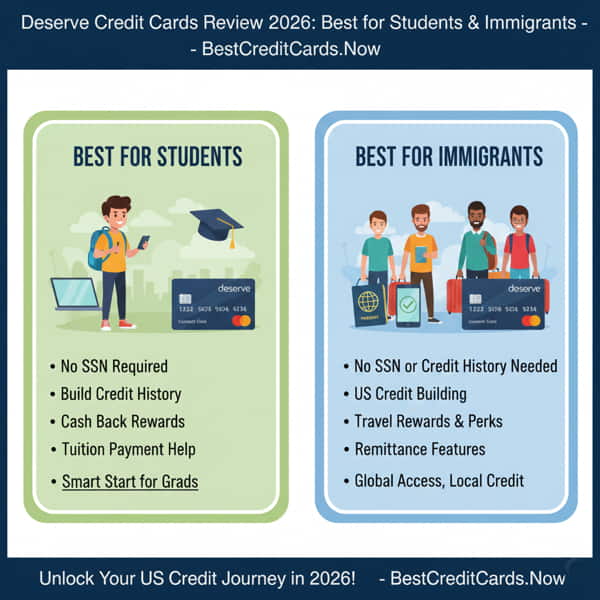
Introduction: The Biggest Barrier in American Credit
The American credit system has long trapped newcomers in a frustrating loop — you can’t get a credit card without a history, and you can’t build a history without a credit card. For international students and new immigrants, this problem runs even deeper: most traditional banks won’t even process an application without a Social Security Number.
Deserve was built specifically to break this cycle. Its model was genuinely innovative, and the gap it filled is still very real in 2026 — which is exactly why understanding it remains relevant even after its discontinuation.
1. The Deserve Philosophy: Creditworthiness Beyond FICO
Deserve’s core premise was simple but powerful: a thin credit file shouldn’t be a permanent barrier to financial access.
Rather than relying solely on a three-digit FICO score, Deserve used a proprietary underwriting engine that evaluated applicants on education history, field of study and projected earnings potential, current bank account management, and visa/enrollment documentation instead of requiring an SSN.
This made it genuinely accessible to international students arriving at US universities — a demographic almost entirely shut out by traditional issuers. For a broader look at how alternative credit evaluation works, see: How to Get a Credit Card with No Credit History in 2026: Your Starter Guide.
2. What the Deserve EDU Mastercard Offered
While the card is no longer available to new applicants, its feature set remains a useful benchmark for evaluating today’s student card alternatives.
The core benefits were: $0 annual fee, $0 foreign transaction fees, 1% cash back on all purchases (automatically credited in $25 increments), one year of Amazon Prime Student after spending $500 in the first three billing cycles, and up to $600 in cell phone protection when you paid your monthly bill with the card.
Credit building mechanics: Deserve reported payment history to Experian and TransUnion. Crucially, international students who later received an SSN could link their established credit history to it — giving them a meaningful head start over peers who waited. This foundation is exactly what our Best Credit Cards to Build Credit in 2026 guide is built around.
The limitations worth knowing: The APR ran around 22.99% variable — high by any standard. No balance transfer or cash advance option was available. Cash back redemption was restricted to statement credits only, with a $25 minimum threshold. For anyone who carried a balance, the interest charges could easily outweigh the rewards earned. This is why responsible usage from day one is non-negotiable — How to Use a Credit Card Responsibly for Beginners is required reading before applying for any starter card.
3. Why the Closure Matters — and What It Teaches
Deserve’s shutdown carries a real lesson for anyone building credit from scratch: your oldest credit account has the most impact on your score. When a card closes — whether voluntarily or because the issuer shuts down — that account’s age eventually stops counting, and your average credit age drops.
For students who had Deserve as their only US credit card, this closure likely caused a noticeable score dip. If that describes your situation, How Long Does It Take to Repair Bad Credit in 2026? gives a realistic recovery timeline.
The broader lesson: when choosing your first credit card, opt for issuers with long track records and large asset bases — they’re far less likely to exit the market unexpectedly. Credit Score Unlocked: The 2026 Definitive Guide explains in detail how account age affects your score and why card selection matters long-term.
4. The 2026 Economic Context: Why This Market Matters More Than Ever
The demand for accessible student and immigrant credit cards hasn’t decreased — it’s grown. With ongoing US trade tensions and tariff-driven inflation pushing living costs higher, international students and new immigrants face tighter budgets than ever. At the same time, the Consumer Financial Protection Bureau has continued pushing for more inclusive underwriting standards — meaning more issuers are gradually expanding their criteria.
The student credit card market is also being reshaped by rising delinquency rates among young borrowers, prompting some issuers to tighten approval standards even while others move into the space Deserve vacated. Understanding where you stand before applying saves hard inquiries. See: Credit Card Pre-Approval vs Pre-Qualification: Understanding the 2026 Difference.
5. The Best 2026 Alternatives for Students and Immigrants
Deserve’s exit left a genuine gap. Here are the most credible options filling it today:
Discover it® Student Cash Back: Requires an SSN, but offers one of the strongest rewards structures in the student segment — 5% cash back in rotating quarterly categories, 1% on everything else, and a full first-year cash back match. Discover also has a strong track record with thin-file applicants. Full comparison at Best Student Credit Cards in 2026.
Capital One SavorOne Student: Earns 3% on dining, entertainment, and popular streaming services — a strong fit for actual student spending patterns. No foreign transaction fees and no annual fee.
Secured cards via major issuers: If you’re unable to qualify for an unsecured card, a secured card from Discover, Capital One, or Citi provides the same credit-building mechanics with minimal approval friction. Your deposit becomes your limit, and payment history reports to all three bureaus. Best Credit Cards for Bad Credit in 2026 covers the best secured options available now.
ITIN-based applications: If you don’t yet have an SSN, an Individual Taxpayer Identification Number (ITIN) can unlock applications at select issuers including some American Express products. Check directly with each issuer, as policies vary and change frequently.
If you’re rejected on your first attempt, don’t apply again immediately — understand why first. Credit Card Application Denial Common Reasons in 2026 walks through the specific flags lenders look for and how to address each one.
6. The Graduation Plan: What Comes After Your Starter Card
Your first credit card — whether Deserve was or a current alternative is — is just the entry point. The real goal is to use it as a launchpad.
After 12–18 months of on-time payments and low utilization, your score should be approaching the 680–700 range. At that point, you can realistically apply for cards offering 2–3% cash back, travel rewards, or sign-up bonuses worth $200–$500. See what’s available: Best Cash Back Credit Cards in 2026 and Best Travel Credit Cards in 2026.
A solid credit foundation also opens doors well beyond credit cards — auto loans, apartments, and eventually mortgages all become more accessible. What is a Good Credit Score to Apply for a Loan in 2026? explains what lenders actually look for at each stage.
For the complete roadmap from zero credit history to a strong financial profile, Best Credit Cards 2026 — Credit History Zero to Hero is the guide to bookmark.
Final Word
Deserve EDU was genuinely one of the most thoughtful credit products built for international students and immigrants in recent memory. Its closure is a real loss for that demographic. But the need it addressed hasn’t gone away — and in 2026, between secured cards, ITIN-friendly issuers, and strong student products from Discover and Capital One, there are credible paths forward.
Start with pre-qualification, choose an issuer with staying power, pay your balance in full every month, and treat your first credit card as a long-term asset — not just a payment method.

Does Paying Bills with a Credit Card Build Credit: The Smart Way to Pay

How Long Does It Take to Repair Bad Credit in 2026? A Realistic Timeline for Recovery

Credit Card Terms to Know in 2026: Your Essential Glossary
About The Author
