Credit Card Fraud Lawyer 2026: Expert Legal Defense & Victim Rights
Credit Card Fraud Lawyer 2026: Expert Legal Defense & Victim Rights
Introduction: Fraud Is Getting Smarter — And More Common
Credit card fraud in 2026 is nothing like what it was just a few years ago. Today’s criminals use deepfake voice cloning to bypass bank verification systems, AI-generated phishing emails that perfectly mimic your bank’s branding, and cross-border skimming operations that never touch your physical card. The result? Record-breaking fraud numbers across the US.
And the economic backdrop makes it worse. With ongoing US-China trade tensions, sweeping tariff increases on consumer goods, and household debt surpassing $18 trillion in early 2026, financial stress is pushing fraud rates even higher. When economic pressure mounts globally, fraud — both real and falsely alleged — rises with it.
Whether you’re a victim whose bank is refusing to reverse an unauthorized charge, or someone wrongly accused of a financial crime, a credit card fraud lawyer may be one of the most important calls you ever make. This guide walks you through exactly when you need one, what legal protections exist, and how to recover afterward.
1. When Do You Actually Need a Credit Card Fraud Lawyer?
Most people assume their bank’s “Zero Liability” policy covers everything. It usually does — but not always. Before assuming you’re fully protected, read our full breakdown: Zero Liability Policy Credit Card Meaning: Your 2026 Guide to Fraud Protection.
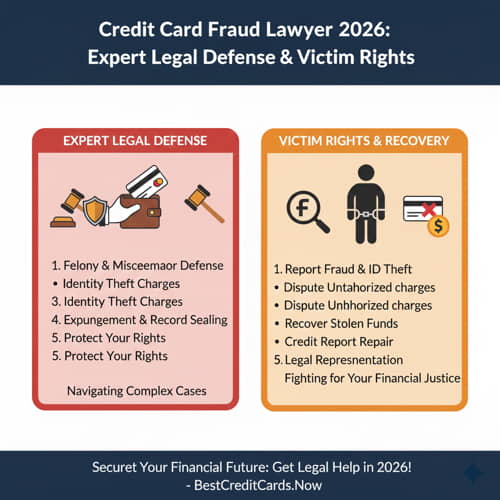
As a victim, you need a lawyer when:
- Your bank denies your fraud claim, classifying it as “friendly fraud” (their algorithm believes you made the charge)
- Unauthorized charges total $2,000 or more
- Fraudulent accounts have been opened in your name, damaging your credit score
- Your bank exceeds 30 days without resolving your dispute
- Your identity was used across multiple accounts or states
As someone accused: Even a first-time credit card fraud charge carries severe consequences. See our detailed guide on First Time Offense Credit Card Theft 2026: Laws & Consequences — federal prosecution, heavy fines, and prison time are all real possibilities, and “I didn’t know” rarely holds up in court without skilled legal counsel.
2. The Laws That Protect — and Prosecute — You
The US legal framework around credit card fraud is layered. Federal law sets the baseline; states add their own penalties on top.
Fair Credit Billing Act (FCBA): The primary federal consumer protection law. It caps your liability at $50 for unauthorized charges, but only if you report promptly. Most major issuers waive that $50 under Zero Liability policies — though that waiver is discretionary, not guaranteed by law. The FCBA full text is maintained by the FTC.
Electronic Fund Transfer Act (EFTA): Governs debit cards with stricter timelines. Report within 2 days: $50 maximum liability. Wait more than 60 days after receiving your statement: potentially unlimited liability. This is a critical reason why debit cards are riskier than credit cards for fraud victims.
Federal Wire Fraud Statute (18 U.S.C. § 1343): The primary tool prosecutors use against the accused. Conviction carries up to 20 years in federal prison — rising to 30 years when a financial institution is directly involved.
State Laws: California, New York, and New Jersey have some of the toughest identity theft statutes in the country, with state charges often running concurrently with federal charges. For a full breakdown of the legal landscape, see: The Legal Landscape: Your 2026 Guide to Credit Card Laws.
3. How a Defense Lawyer Builds Your Case
A skilled fraud attorney in 2026 must understand both the law and the technology behind digital transactions. Here’s how they typically approach a defense:
Lack of Intent: Fraud requires willful, deliberate deception. If your device was compromised by malware and you had no knowledge of the fraudulent transactions, that can be a complete defense.
Mistaken Identity: With IP-spoofing, VPNs, and AI-generated digital footprints, innocent people are regularly linked to crimes committed by hackers. Cyber-forensic experts frequently serve as key defense witnesses in these cases.
Procedural Violations: If law enforcement obtained your digital records without a proper warrant, that evidence may be suppressible. Experienced fraud attorneys probe this immediately.
Duress: Less common, but legally valid in cases where someone was coerced into participating in fraud under direct threat.
The FTC’s identity theft resources are also a valuable starting point for both victims and anyone navigating an accusation.
4. The 2026 Economic Factor: Why Fraud Is Surging
This is the context most legal guides skip — but it’s essential for understanding the current environment.
US tariff disputes with China and the EU have driven consumer prices sharply higher across virtually every category. Household financial stress is measurable: delinquency rates on credit cards have been climbing since late 2024, according to the Federal Reserve’s consumer credit data. When people are under financial pressure, two things happen simultaneously: fraud attempts increase, and banks’ fraud-detection algorithms become more aggressive — meaning more innocent people get falsely flagged.
For business owners specifically, chargeback fraud — where customers falsely claim non-receipt of goods — is at a historic high in 2026. A fraud attorney can help you build Terms of Service and transaction documentation that hold up in arbitration. Choosing the right financial tools also matters: see Best Business Credit Cards in 2026: Power Your Enterprise for cards with the strongest merchant protection features. For broader business financial strategy, Credit Cards and Business Success: Your 2026 Essential Guide is worth reading as well.
5. How to Choose the Right Fraud Lawyer
Not every attorney is equipped for digital-age fraud cases. When evaluating candidates, ask specifically about:
- Cyber-forensic literacy: Do they understand NFC skimming, account takeover attacks, and AI-generated phishing? Ask directly — vague answers are a red flag.
- Federal court experience: Most serious fraud cases cross state lines, landing in federal jurisdiction under the FBI or Secret Service.
- Track record fighting bank denials: Some attorneys specialize specifically in disputing bank claim rejections — a different skill set from criminal defense work.
- Transparent fee structure: Initial consultations are often free. Be cautious of flat-fee quotes without a case review first.
For a broader overview of your consumer rights in disputes, How to Dispute a Credit Card Charge in 2026 is a practical companion read.
6. Prevention: Reducing Your Risk Before You Need a Lawyer
The best legal strategy is not needing one. A few habits that meaningfully reduce your exposure:
Monitor statements actively. Read The Best Way to Monitor Credit Card Statements for Fraud in 2026 for specific tools and workflows.
Freeze your credit when you’re not actively applying for new accounts. All three bureaus (Equifax, Experian, TransUnion) offer free freezes. This single step blocks most new-account fraud entirely.
Use virtual card numbers for all online subscriptions and one-time purchases. Major issuers like Capital One and Citi offer these natively.
Understand your card’s actual protections. Not all “Zero Liability” policies are equal. Credit Card Security Tips in 2026: Protect Your Financial Identity covers the practical details.
7. Rebuilding After a Fraud Incident
Once the legal matter resolves, the financial recovery begins. Here’s a realistic timeline:
Immediately: Place fraud alerts at all three bureaus — free, lasts one year, and can be extended to seven years for confirmed identity theft victims under the FCRA.
1–6 months: Work with your lawyer to submit formal dispute letters to the credit bureaus for any fraudulent accounts or incorrectly reported late payments. Bureaus must investigate within 30 days under federal law. For timeline expectations, see: How Long Does It Take to Repair Bad Credit in 2026?
6–24 months: Rebuild with a secured card or credit-builder product. Consistent on-time payments are the most effective legitimate path back to a healthy score. Best Credit Cards to Build Credit in 2026 is a good starting point. If you hit repeated application denials, Credit Card Application Denial Common Reasons in 2026 explains exactly what flags to address first.
Conclusion
In 2026, credit card fraud is not a minor inconvenience — it’s a serious legal and financial event with lasting consequences. The combination of sophisticated AI-driven crime, an aggressive bank-side detection environment, and real economic pressure makes professional legal guidance more important than ever.
If you suspect fraud, the sequence is simple: document everything, report to your bank immediately, and consult an attorney before assuming the matter will resolve on its own. For a complete roadmap on protecting and building your financial profile from the ground up, start with: Best Credit Cards 2026 — Credit History Zero to Hero.

How to Apply for a Credit Card in 2026: A Step-by-Step Guide

Understanding Credit Card Grace Period Meaning in 2026: Your Key to Avoiding Interest

The Legal Landscape: Your 2026 Guide to Credit Card Laws
About The Author
