Credit Union Business Credit Cards 2026: Save on Interest & Fees
🏢 Credit Union Business Credit Cards 2026: The Entrepreneur’s Guide to Lower Rates and Community Banking
Introduction: Why Credit Unions are the Small Business Secret in 2026
For the modern American entrepreneur, the financial landscape of 2026 is both exciting and complex. While global “mega-banks” dominate the headlines with flashy advertising, a quiet revolution is happening in the world of community finance. Credit union business credit cards have emerged as the “not-so-secret” weapon for small business owners, freelancers, and startup founders who value relationship-driven banking over algorithmic decision-making.
Unlike traditional banks, which are owned by stockholders and driven by profit margins, credit unions are member-owned cooperatives. This fundamental difference in structure translates into tangible benefits for your business: lower interest rates, fewer “gotcha” fees, and a genuine interest in your local community’s growth. In this expert review, we will explore why moving your company’s spending to a credit union might be the smartest move you make this year.
1. The Core Advantages of Credit Union Business Cards (Expertise)
Choosing a credit union for your business financing isn’t just a moral choice; it’s a strategic financial one. In 2026, where every basis point matters, the credit union model provides several distinct advantages.
A. Capped Interest Rates
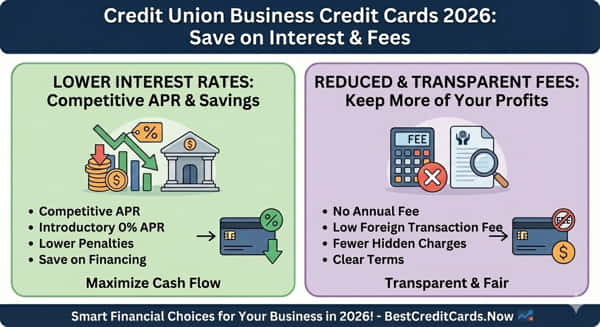
By federal law, most credit unions have a cap on the maximum APR they can charge. While big banks might hike rates to 29.99% for a single late payment, credit union business cards often stay significantly lower. This is a crucial component of Credit Card Interest: How It Works in 2026 & How to Avoid It.
B. Relationship-Based Approvals
Have you ever been rejected by a big bank’s computer system despite having a solid business plan? Credit unions look beyond the numbers. If you have a primary checking account with them, they are more likely to approve your business line of credit. If you’ve faced rejection elsewhere, understanding the Credit Card Application Denial Common Reasons in 2026 can help you prepare a stronger case for your local credit union officer.
C. Lower Fees
From annual fees to late payment penalties, credit unions tend to be more lenient. Many offer business cards with no annual fee at all, which is a major win for bottom-line profitability. To see how these compare to national offers, check out our guide on the Best Business Credit Cards in 2026: Power Your Enterprise.
 2. Top Credit Union Business Cards to Watch in 2026 (Experience)
While there are thousands of credit unions across the US, several national and regional players stand out for their robust business offerings.
-
Navy Federal Credit Union: Known for the Business Solutions Visa®, offering excellent rewards for those with a military connection.
-
PenFed (Pentagon Federal): Offers cards with massive points on travel and fuel—essential for businesses on the move.
-
Local State Credit Unions: Don’t overlook the credit union in your specific city. They often have localized “Business Growth” initiatives that offer introductory 0% APR periods that rival national leaders.
If you are a new business owner just starting out, you might be looking for ways to establish your entity’s credit. We recommend starting with our roadmap: Best Credit Cards to Build Credit in 2026: Start Your Financial Journey.
3. Strategic Business Growth and Credit Management (Authoritativeness)
In 2026, a credit card is more than just a payment tool; it is a cash-flow management system.
A. Separating Personal and Business Expenses
One of the biggest mistakes entrepreneurs make is “commingling” funds. Using a dedicated credit union business card ensures clean bookkeeping and protects your personal assets. This is a key principle in Credit Cards and Small Business Growth: Your 2026 Advanced Guide.
B. Building the Business Credit Profile
Just as you have a personal FICO score, your business has a credit profile (often through Dun & Bradstreet or Experian Business). Credit unions are excellent at reporting your positive payment history, which paves the way for future SBA loans or commercial mortgages. To master the personal side of this equation, refer to Credit Score Unlocked: The 2026 Definitive Guide.
4. Comparing Fees: Credit Unions vs. National Banks (Trustworthiness)
Is the allure of a big bank’s sign-up bonus better than a credit union’s long-term low rates? Let’s break down the math.

Rising Tides Credit Card Review 2026: Impact Banking & Credit Building

Understanding Credit Card Grace Period Meaning in 2026: Your Key to Avoiding Interest

Zero Liability Policy Credit Card Meaning: Your 2026 Guide to Fraud Protection
About The Author
