Vending Machine Credit Card Reader 2026: The Ultimate Guide
🛒 Vending Machine Credit Card Reader 2026: The Ultimate Guide to Cashless ROI and Smart Telemetry
Introduction: The Cashless Revolution of 2026
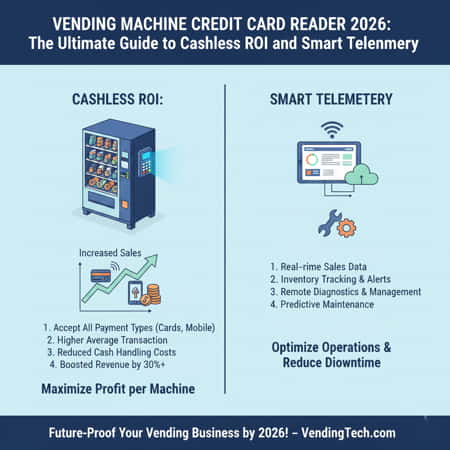
In 2026, the phrase “exact change only” has become a relic of the past. As we navigate a hyper-digital economy, the convenience of a vending machine credit card reader is no longer a luxury for operators—it is a baseline requirement for survival. With over 80% of US consumers preferring contactless payments and mobile wallets like Apple Pay and Google Pay, a vending machine that only accepts coins and crinkled dollar bills is essentially a “closed” sign to a huge segment of the market.
For vending machine owners, the transition to cashless isn’t just about customer convenience; it’s about data, efficiency, and significant revenue growth. Statistics in 2026 show that machines equipped with modern readers see a 35% to 50% increase in total sales. But which reader should you choose? How do the fees work? And how do you ensure your machine is secure against the latest fraud tactics?
This guide dives deep into the technology, the top providers like Nayax and Cantaloupe, and the financial strategy behind the ultimate vending upgrade.
 1. How Do Vending Machine Credit Card Readers Work? (Expertise)
The modern vending card reader is much more than a simple swipe tool. It is a sophisticated IoT (Internet of Things) device that handles payment processing, data encryption, and inventory management simultaneously.
A. The Payment Process in Milliseconds
When a customer taps their card or phone:
-
Interaction: The reader uses NFC (Near Field Communication) or EMV (Chip) technology to capture encrypted payment data.
-
Encryption: The data is instantly “tokenized,” ensuring that no sensitive card information is stored on the reader itself.
-
Authorization: Using a 4G/5G cellular connection, the reader sends the request to the payment processor. This is similar to the security protocols discussed in our guide on The Best Way to Monitor Credit Card Statements for Fraud in 2026.
-
Confirmation: The issuing bank approves the transaction, and the machine dispenses the product—all in under 3 seconds.
B. MDB and Compatibility
Most modern machines use the MDB (Multi-Drop Bus) protocol. This is the universal language that allows the card reader to talk to the machine’s control board. If you have an older machine, you might need a “Pulse” adapter, but in 2026, MDB is the gold standard for seamless integration.
2. Why Your Business Needs to Go Cashless Now (Authoritativeness)
The ROI on a vending machine credit card reader is often realized within the first six months. Here’s why the investment is a “no-brainer” for 2026:
A. Higher Average Transaction Value
When people pay with cash, they are limited by the physical coins in their pockets. When they pay with a card, they are more likely to make “impulse” buys or select premium, higher-priced items. This psychological shift is well-documented in our analysis of How to Use a Credit Card Responsibly for Beginners: Your Smart Start Guide, where we explore how digital payments change consumer spending habits.
B. Telemetry: The Secret Power of Data
Modern readers come with “Telemetry” software. This allows you to log into an app (like Nayax Core or Cantaloupe Seed) and see:
-
Exactly how many Snickers bars are left.
-
Real-time sales reports.
-
Alerts if the machine loses power or a coin jam occurs.
By optimizing your routes based on data, you save on gas and labor, effectively “repairing” your business’s bottom line. If you are a small business owner looking to optimize your overhead, understanding credit management is vital—check our tips on the Best Credit Cards to Build Credit in 2026 to see how your business credit can help you scale your vending route.
3. Comparing the Top 2026 Reader Providers (Experience)
Selecting the right hardware is the most critical decision in your vending journey. Here is a breakdown of the 2026 market leaders.
A. Nayax (VPOS Touch & Onyx)
Nayax remains the global leader due to its “all-in-one” approach.
-
Pros: Supports over 80 payment integrations, excellent mobile app (MoMa), and built-in marketing tools like loyalty programs.
-
Cons: Monthly service fees can be slightly higher than competitors.
B. Cantaloupe (ePort G11)
A favorite for large-scale US operators.
-
Pros: Rugged hardware, exceptional integration with Seed VMS (Vending Management System), and highly reliable 4G/LTE connectivity.
-
Cons: The user interface on their web portal can feel a bit dated compared to Nayax.
C. Parlevel Pay
Ideal for operators who want a deep dive into inventory analytics.
-
Pros: The most advanced “pre-kitting” software, allowing you to know exactly what to pack in your truck before you leave the warehouse.
-
Cons: Hardware is robust but often requires a slightly longer setup time.
Before investing thousands in hardware, ensure you have the right financial backing. Many operators use low-interest cards for equipment. Explore the Best 0% APR Credit Cards in 2026: Your Path to Interest-Free Freedom to fund your reader upgrades without immediate interest costs.
4. Understanding Fees and The “Convenience Fee” Model
Operating a vending machine credit card reader isn’t free. You generally face two types of costs:
-
The Monthly Service Fee: Usually $10–$20 per machine to maintain the cellular connection and software access.
-
The Transaction Fee: Typically 5% to 6% per swipe.
The Solution: Passing the Fee to the Consumer
In 2026, it is standard practice to use a “Two-Tier Pricing” model. You set the machine price at, say, $1.75 for cash but $1.85 for credit. Most consumers are happy to pay a $0.10 “convenience fee” for the ease of tapping their phone. This ensures your margins stay healthy even after the bank takes its cut. For more on how these transaction dynamics work, see Credit Card Interest: How It Works in 2026 & How to Avoid It.
5. Security and PCI Compliance (Trustworthiness)
With the rise of “shimming” and “skimming” devices, security is a top concern for 2026. A high-quality reader must be PCI DSS Compliant.
-
Point-to-Point Encryption (P2PE): This ensures that the card data is encrypted the moment it touches the reader and stays encrypted until it reaches the processor.
-
EMV Chip Technology: Swiping a magnetic stripe is increasingly unsafe. The 2026 standard is “Tap or Dip,” which uses a one-time code for every transaction, making it impossible for hackers to clone the card.
If you are worried about your own personal credit safety while managing these business accounts, we recommend reading Credit Score Unlocked: The 2026 Definitive Guide to keep your financial profile secure.
6. Steps to Install Your First Card Reader
Ready to upgrade? Here is the 2026 checklist:
-
Check Your Machine: Ensure it is MDB-ready. If it was made after 2005, it likely is.
-
Order Hardware: Choose between a Nayax VPOS Touch (screen-based) or a more affordable “blind” reader like the Onyx.
-
Create Your Merchant Account: You will need to provide your EIN (Employer Identification Number) and bank details for daily/weekly payouts.
-
Physical Installation: Most readers only require drilling one or two small holes and plugging a single cable into the machine’s control board.
-
Test and Activate: Swipe your own card to ensure the “MDB communication” is successful.
If your credit history is thin and you’re struggling to get approved for merchant services, don’t worry. You can start building today with the Best Credit Cards 2026-Credit History Zero to Hero roadmap.
7. The Future of Vending: Biometrics and AI (2026 and Beyond)
As we look toward the end of 2026, the vending machine credit card reader is evolving again.
-
Face-to-Pay: High-traffic locations are experimenting with facial recognition payments linked to loyalty apps.
-
AI Dynamic Pricing: Readers can now suggest price changes based on the time of day or local weather (e.g., raising the price of cold water during a heatwave).
-
Micro-Markets: The reader is becoming the “kiosk” for entire unstaffed breakroom stores.
Conclusion: Is the Investment Worth It?
In 2026, the data is undeniable. A vending machine without a credit card reader is leaving money on the table every single hour. Whether you are a small operator with one machine or a fleet owner with hundreds, the jump to cashless is the most effective way to scale your revenue, secure your cash flow, and gain total control over your inventory.
By leveraging modern financing—perhaps using one of the Best Credit Cards for Big Sign-Up Bonuses in 2026 to purchase your readers—you can turn a simple snack machine into a high-tech, 24/7 revenue engine.
Credit Card Fees to Avoid in 2026: Save Your Money
How to Close a Credit Card Account in 2026: A Smart Guide

Understanding Credit Scores in 2026: Your Financial Blueprint
About The Author
